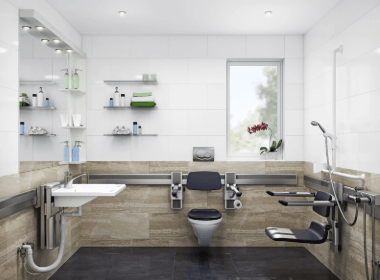
Bathroom renovations have been hailed as part of a “boom” with many interpreting the trend to mean homes are being updated with great looks to sell for a profit. But new figures point to a more profound influence: accessibility. And it appears that accessibility is driving renovations at an all time high, with many homeowners willing to spend thousands of dollars to create bathrooms that are easier to enter. But what’s behind the shift?
The demographics driving change
The Australian population is ageing, but it’s not just senior Australians that are getting older. One in four Australian will be over 65 by 2061, but there is more to the story than that.
Rather than simply building or renovating a home with older parents in mind, many families are now designing their homes with both the parents, and the grown children and their elderly parents (the children’s parents) in mind. There is “the accessibility deficit”, an important term used by researchers to describe the difference between most people’s ability to get around and the design of most Australian homes. For most people with disability, 18% of the Australian population, their home is not accessible to them. Many Australian families with members with disability would be able to tell stories about a parent coming to live with them, only to find that the home is not equipped with accessible features such as a walk-in shower.
Most accessibility features are designed with older individuals in mind, but there are also younger demographics that may need similar features in their homes. Although you are young and healthy, accidents can happen to anyone. If you have a sports injury, work accident injury, or disability, you may need short-term accessibility features in your home until you recover from your injuries. Until you fully recover from injuries such as a broken leg or knee surgery, getting around the house to take showers or baths may be difficult. Although some temporary solutions are intended to be short-lived, they can become long-term accommodations.
Beyond compliance thinking
When I started out as an Accessibility Specialist, I often operated under the assumption that meeting the minimum requirements for accessibility would be sufficient. And while installing required grab bars, widening doorways, creating appropriate ramps with the correct slope can make a space accessible on paper, it’s not a guarantee that the final product is fully accessible to all users.
This became increasingly clear to me as I began to spend more time in spaces designed for people with disabilities. Often, it is only after spending time “in the shoes” of the individuals for whom a space is being designed that holes in the plan are revealed.
It is rare to encounter accessible design where the benefits to ALL users have been considered. It is widely accepted that good accessible design benefits the community as a whole, and is not only of use to and benefit people with disabilities. For example, the accessible design of a curbless shower entry is comforting to a wheelchair user, but removes a trip hazard and prevents dirty water accumulating in the shower track grooves for parents to scrub out weekly! An accessible shower stool to hold a person’s leg whilst they are shaving their legs is not just useful to people with significant mobility difficulties, it is safer for ANYONE who wishes to shave their legs.
For me, the most exciting shift in the conversations I have with my clients is that what used to be: “What is the minimum that we can do to make this work?” is now: “How can we make this work better for all of us?”
See also: Entryway Bench Design Ideas
The renovation reality check
Good intentions collide with practical constraints.
Accessible bathroom renovations can be up to 15 to 30 percent more expensive than typical renovations. This increased cost comes from the need to install grab bars, use waterproof surfaces in curbless showers, and complete additional electrical work to power comfort height fixtures like lowered sinks and toilets. Older homes, like Victorian-style homes, can be even more difficult to transform into an accessible bathroom because they were not originally designed to include spaces for wheelchairs or mobility aids. Depending on the age and design of your home, making significant changes to accommodate an accessible bathroom could add significantly to the renovation cost. Many families have discovered that what seems to be a relatively simple home improvement can quickly unravel into a much bigger renovation. Common upgrades like expanding a master suite or turning a basement into a rec room can soon require replumbing and rewiring, or even changes to the home’s foundation.
Even when products are available for a Trade Availability product (ie. off the shelf), there can be a long wait for an accessible bathroom installer to become available. This wait can be for several months or longer in some locations around Australia. Many qualified accessible bathroom installers around Australia are fully booked and unable to provide a quote or appointment within a reasonable timeframe for homeowners. It is not uncommon for homeowners to be quoted long delays of several months for work to begin. Other specialist fixtures such as electic adjustable height (EAH) or steamout shower chairs, may also require longer lead times or specialist installers.
Insurance gaps and funding frustrations
There is no funding to achieve better hospital discharge practices. Private health insurance may fund home modifications for individuals who require these modifications to avoid readmission to hospital. Funding is available through initiatives such as Medicare and Community Hospitals, but funding is also available through programs such as the Home and Community Care Programme. However, this funding is often unavailable to middle-income patients who earn too much to be considered eligible for government funded community based care services but do not have sufficient income or assets to pay for the major home modifications required.
While NDIS participants are generally coming out ahead under the new system, many are suffering because of persistent delays in the funding approvals process. Occupational therapist Fiona Lewis says that by the time she finally gets approval for funding, her clients’ needs have often changed.
Looking ahead: universal design becomes mainstream
We’ve been fighting for accessible toilets for many years, but it seems the battle has finally been won.
Incorporating Universal Design into buildings is becoming more prevalent and more regulated, particularly with upcoming accessibility provisions in the National Construction Code for access to homes. This will significantly impact new residential construction. In addition to these building code changes, accessible homes are also incorporating technology that can be controlled with the sound of your voice. Prefabricated accessible bathroom modules can be an affordable and convenient solution for renovation. No longer do accessibility features come with a tinge of stigma. The way society views accessibility has dramatically shifted in recent years. We no longer talk about accessibility in the same way we once did; the way we promote products with accessibility features has changed to emphasize the thoughtfully designed product for older users.
Accessible bathrooms are thought of by many as a medical requirement for people with disabilities; however, they can also be a “smart” long-term design consideration for any family. With the current boom in bathroom renovation, accessibility is no longer considered a requirement for people with disabilities. Instead, accessible bathrooms are now a feature that is functional for and useful to anyone, regardless of age, ability, or circumstance.